Thursday, November 4, 2010
The USGA Green Section Record
I have a hard time keeping my desk clean because of bills, paperwork, and most of all, magazines. I must get 10 to 15 turf related publications each month and I usually do not find the time to read more than a couple articles. There is one that I look forward to, and have since college when I would grab a copy outside of the Turf Science office at Purdue. If you read the title, you already know that I'm speaking of the USGA Green Section Record.
Just a few months ago, the USGA sent out a notice that they would discontinue printing the Record and begin to offer it online. I was very disappointed because I knew I'd forget to check the website and would no longer have the luxury of holding the magazine in my hand and taking it where I please. They proved me wrong very quickly. Instead of a size constrained paper edition that only arrives monthly, they've gone to weekly email updates with more content and an updated, professional look. The new format includes regional updates from around the country, a searchable archive of past issues, links to webcasts, and very interesting stories. For example, the October 12 issue included a story about Superintendent Paul Chojnacky and the crew at Pasatiempo Golf Club in Santa Cruz, California using goats to clear vegetation on the severe slopes of the golf course. Everyone should know about the work of great courses and great superintendents like Paul who is solving a problem in a cost-effective and environmentally friendly manner.
I encourage all of you to sign up to receive the USGA Green Section Record. It does not cost a penny and it will not clog up your inbox with ads and solicitations. Just go to the first link on this post, scroll to the bottom and click on the icon. No personal information is needed, just your email. Enjoy.
Wednesday, October 27, 2010
Overseeding Methods
Our yearly overseeding program has drastically decreased from what it was a couple of years ago. We used to put out over 20,000 pounds of seed and spend about $35,000 on the practice including the fertrilizer, growth regulators, and amendments to make it work. The last two years, we've stopped seeding the fairways and primary rough. The ryegrass we put out is limited to the tees, approaches, green surrounds, and a few lawns near the clubhouse. Besides that, we let the poa annua come in and provide a playing surface for the golfers. With a monthly application of iron sulfate, we keep the turf fairly green and most people can't tell the difference. The real appeal of this change in turf management is a financial savings of $30,000 plus a reduction in course down time. Rounds are up and so are outside tournaments. From an agronomic standpoint, I prefer to battle poa annua rather than ryegrass when we attempt to burn it out and promote our bermudagrass. It's been a win-win so far, and I think it's here to stay.
There are many different ways to get your ryegrass going and it can be as simple or as complicated as you like. My favorite is the simple broadcast method that takes no time and little effort while producing great results. The crew at Stockton Golf and Country Club taught me this simple technique of blasting out ryegrass through a fertilizer spreader and dragging it in with a metal fence. We open up the spreader all the way and spread seed from the green collar to the rough to spruce up the green surrounds. This is also a great method for your homelawn and is really as simple as spreading some seed and keeping enough moisture on it to germinate.

I took the above picture last weekend on #10 green surround. This area is primarily common bermuda and would be brown once the first frost shows up. Two weeks after broadcasting the seed, we have some thin, yellowish leaves emerging. After a shot of fertilizer and some more time, we will have dark green turf around all the greens.
For the tees, we used a walk-behind seeder called a Mataway. Marvin and Richard stopped going to the gym for a few weeks and got their excercise seeding the tees in three directions. This is a lot of work and a lot time, but the results are worth it.

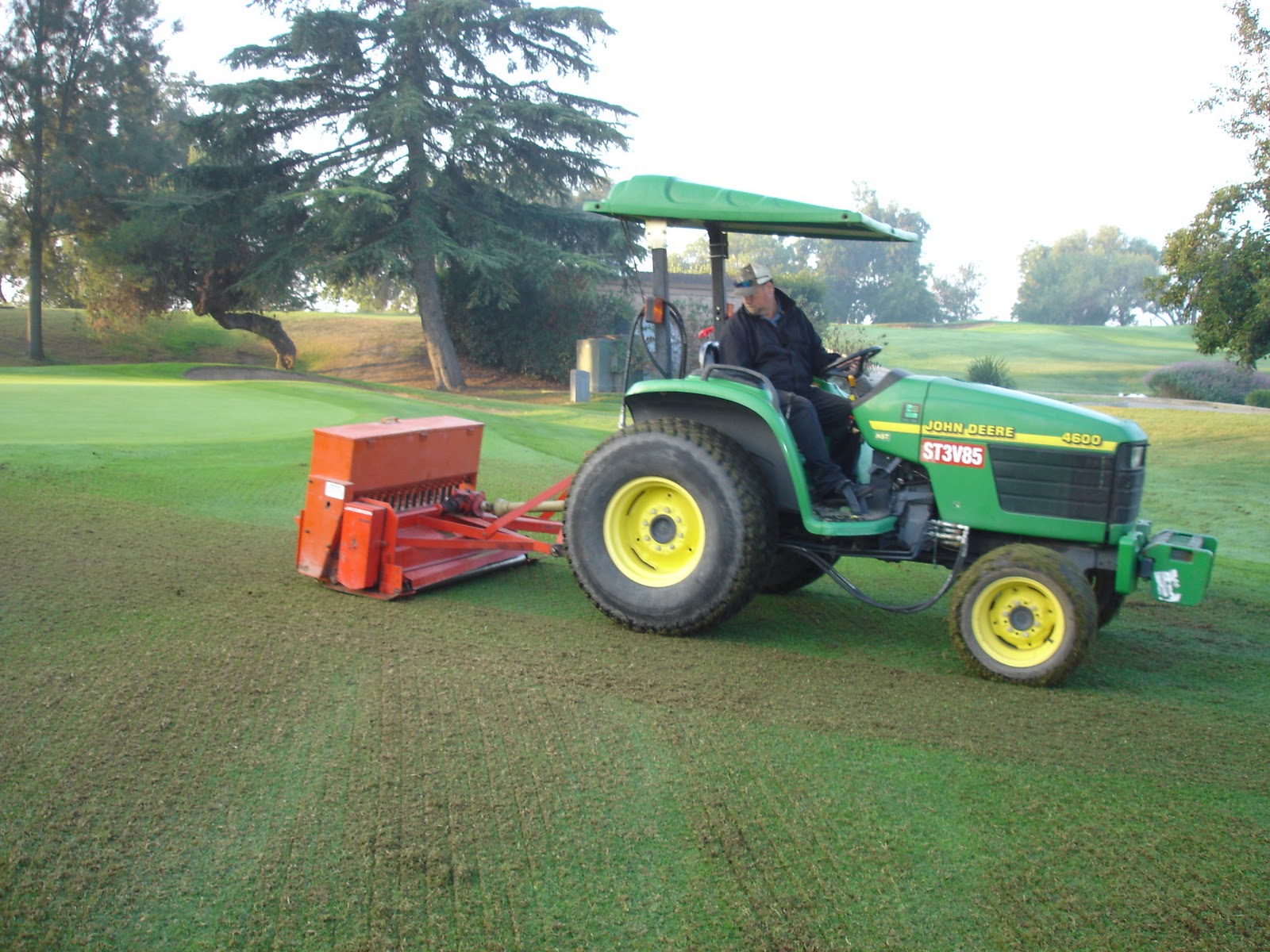
The approaches endured a much more aggressive treatment with a tractor-mounted slit seeder going in 3 directions. This ripped out a tremendous amount of thatch and bermuda stolons. This work should firm up the approaches and improve the drainage. The seed will take a little while to fill in, so please be patient.

On all the tees and approaches we follow up the slit seeding with an additional broadcast seeding and a layer of sand. Once the sand is in place, we drag the area with a steel mat to work in the sand and smooth the surface. Finally we hit it with some fertilizer and water it all in. Irrigation is handled differently during germination. Normally we will water deep and infrequent. The seed requires the exact opposite so we will water multiple times for just a couple of minutes.

More updates to come in the near future. Other projects going on include flower beds and landscape work, manually cleaning duckweed out of the ponds, renovating the native area on #2, and getting ready to embark on the new tree program which will be fun. Stay tuned.

I took the above picture last weekend on #10 green surround. This area is primarily common bermuda and would be brown once the first frost shows up. Two weeks after broadcasting the seed, we have some thin, yellowish leaves emerging. After a shot of fertilizer and some more time, we will have dark green turf around all the greens.
For the tees, we used a walk-behind seeder called a Mataway. Marvin and Richard stopped going to the gym for a few weeks and got their excercise seeding the tees in three directions. This is a lot of work and a lot time, but the results are worth it.

The approaches endured a much more aggressive treatment with a tractor-mounted slit seeder going in 3 directions. This ripped out a tremendous amount of thatch and bermuda stolons. This work should firm up the approaches and improve the drainage. The seed will take a little while to fill in, so please be patient.
 |
| Assistant Superintendent, Rob Williams seeding on #7 approach. |
 |
| Here is the result on a bermuda approach. |
 |
| Geronimo, Mario, and Ricardo cleaning up the mess and chasing after Rob. |

On all the tees and approaches we follow up the slit seeding with an additional broadcast seeding and a layer of sand. Once the sand is in place, we drag the area with a steel mat to work in the sand and smooth the surface. Finally we hit it with some fertilizer and water it all in. Irrigation is handled differently during germination. Normally we will water deep and infrequent. The seed requires the exact opposite so we will water multiple times for just a couple of minutes.

 |
| Here is #13 approach after it is all said and done. 2 weeks from now should look better. |
Wednesday, October 20, 2010
2010 Ladies Invitational
This tournament is always a nice change of pace because priorities for the condition of the course are much different than most male dominated events. Nobody is expecting or wants greens to be rolling 12 on the stimp meter. They don't expect the course to be so dry, it is near death, making playing conditions more difficult. They want an enjoyable round on a well kept and well decorated course.
I learned this lesson the hard way during my first Ladies Invitational. I double cut and rolled the greens and spent more time on creating tough conditions than polishing the place for all the guests. Next time around, I understood what was expected. We focused on presentation and tried to make a few special spots throughout the course. The members really are the ones who deserve the credit, spending many hours decorating the course to match the event's theme.
This year, the tournament followed a nautical theme with small sailboats as tee markers, the proshop looking like some kind of fancy golf marina, and even hand-sewn flags strung onto the flagsticks.

I really wanted to get a few sailboats to float in the lakes and maybe one to park on the driving range tee, but I never got it done. However, we were able to make our own with halfway decent results.

The tournament went very well in every aspect and I think the members were proud of the course, clubhouse, staff, and their own hard work to make everything excellent. Down in the maintenance department, we're looking forward to next time. I wonder what the theme will be?
Subscribe to:
Posts (Atom)